
(Our apologies to AT - we have removed our additional apartment images from this blog.)
Although this time in a different capacity. We both entered our apartments (pictured below) in the 2008 Smallest Coolest Contest. The requirements are simple: the space has to be your primary residence and it has to be small (under 650 square feet). You can view the open critique of our small homes and vote for how cool you think it is.
*boy's entry here.
*girl's entry here.
Stayed tuned for more AT Boston posts - our second story should be up this week.
Wednesday, April 9, 2008
Tuesday, April 8, 2008
Not so Shiny Anymore
Now that it's caked in road grime and getting ready for its first spring cleaning, my custom bicycle (hand-built by my little brother) takes center stage here on the blog. Here's the story from welding to riding and a quick how-to for hanging a cycloc.
The color, a very popular subject, is not the actual Bianchi celeste green. It is a color I chose which is somewhere between celeste and Tiffany Blue but it is often mistaken for a Bianchi.


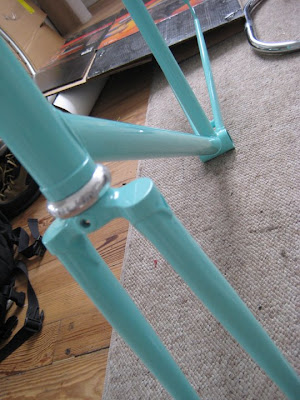


The color, a very popular subject, is not the actual Bianchi celeste green. It is a color I chose which is somewhere between celeste and Tiffany Blue but it is often mistaken for a Bianchi.


Friday, April 4, 2008
Graphic Decorator

Given my profession as a graphic designer, I lean heavily toward bold and colorful interior design. Its not that I don’t think minimal, white spaces can be lovely – they can, much like a good, crisp white paper stock – but when it comes to my own home surroundings, I like things graphic. Currently this manifests itself in the form of brightly painted walls, lots of posters, color-coded books and bold pattern fabrics. But as *boy and I plan our impending move-in, I’m starting to think about channeling my graphic tendencies in a more focused direction that we both can live with.

Wallpaper is back with a vengance these days but I think my love for it actually began as a child in my grandparents’ dining room. The entire foyer and dining area of their house is covered in this handmade wallpaper:

I love it. It’s rich, elegant, graphic and I told my mother I'd never visit again if she dared to rip it down. *boy and I have discussed the possibility of wallpapering the hallway/second entryway in the new apartment and I’m getting pretty excited about it. Here’s a little wallpaper inspiration.


From Studio Nommo, Walnut Wallpaper, and Trove.
Monday, March 31, 2008
Failings of Modernism
And to think, the Modernist movement was touted and intended to raise the standard of living for everyone - albeit through the virtues of industry. In my education there was a certain nostalgia and notion that the general public just didn’t get Modernism because of its abstract qualities and essential forms. Though a little radical this begins to make a lot of sense as you walk through desolate Boston City Hall Plaza.
“The messes we’ve made of places where we live and work is not solely the result of bad buildings, though there are plenty of them. But that hardly lets architects off the hook. Rather, with the hubris of religious zealots, they set out on a great purifying mission that damaged the whole physical setting for civilization of our time. The dogmas that guided them went by the name of modernism. Heretics and skeptics were anathematized as systematically as the opponents of the fifteenth–century Vatican.
Modernism did its immense damage in these ways: by divorcing the practice of building from the history and traditional meaning of building; by promoting a species of urbanism that destroyed age-old social arrangements and, with them, urban life as a general proposition; and by creating a physical setting for man that failed to respect the limits of scale, growth, and the consumption of natural resources, or to respect the lives of other things. The result of Modernism, especially in America, is a crisis of the human habitat: cities ruined by corporate gigantism and abstract renewal schemes, public buildings and public spaces unworthy of human affection, vast sprawling suburbs that lack any sense of community, housing that the un-rich cannot afford to live in, a slavish obeisance to the needs of automobiles and their dependent industries at the expense of human needs, and a gathering ecological calamity that we have only begun to measure.”
The Geography of Nowhere
James Howard Kunstler
“The messes we’ve made of places where we live and work is not solely the result of bad buildings, though there are plenty of them. But that hardly lets architects off the hook. Rather, with the hubris of religious zealots, they set out on a great purifying mission that damaged the whole physical setting for civilization of our time. The dogmas that guided them went by the name of modernism. Heretics and skeptics were anathematized as systematically as the opponents of the fifteenth–century Vatican.
Modernism did its immense damage in these ways: by divorcing the practice of building from the history and traditional meaning of building; by promoting a species of urbanism that destroyed age-old social arrangements and, with them, urban life as a general proposition; and by creating a physical setting for man that failed to respect the limits of scale, growth, and the consumption of natural resources, or to respect the lives of other things. The result of Modernism, especially in America, is a crisis of the human habitat: cities ruined by corporate gigantism and abstract renewal schemes, public buildings and public spaces unworthy of human affection, vast sprawling suburbs that lack any sense of community, housing that the un-rich cannot afford to live in, a slavish obeisance to the needs of automobiles and their dependent industries at the expense of human needs, and a gathering ecological calamity that we have only begun to measure.”
The Geography of Nowhere
James Howard Kunstler
Saturday, March 29, 2008
We're on Apartment Therapy!
One of our favorite design blogs, Apartment Therapy, is expanding its coverage to Boston and we're trying out! We've made it to the finals and our first article is up for voting now. Check it out here, vote and leave some feedback for the judges. We'll be posting two more articles over the next two weeks so keep reading and keep voting!
A little more about what Apartment Therapy is all about and why we would love to be part of their fantastic blog:
Mission
Helping people make their homes more beautiful, organized and healthy by connecting them to a wealth of resources, ideas and community online.
What We Believe
A calm, healthy, beautiful home is a necessary foundation for happiness and success in the world. Creating this home doesn’t require large amounts of money or space. It requires inspiration, connection to resources and motivation to do something about it. The basic elements of good home design can be learned and achieved by all.
Simplicity and luxury are not mutually exclusive.
Our Goal
To connect people to the resources they need to improve their homes, while reducing their reliance on stuff.
A little more about what Apartment Therapy is all about and why we would love to be part of their fantastic blog:
Mission
Helping people make their homes more beautiful, organized and healthy by connecting them to a wealth of resources, ideas and community online.
What We Believe
A calm, healthy, beautiful home is a necessary foundation for happiness and success in the world. Creating this home doesn’t require large amounts of money or space. It requires inspiration, connection to resources and motivation to do something about it. The basic elements of good home design can be learned and achieved by all.
Simplicity and luxury are not mutually exclusive.
Our Goal
To connect people to the resources they need to improve their homes, while reducing their reliance on stuff.
Monday, March 24, 2008
Primary & Pastel
I'm currently working intensely on a brand new Children's Hospital. When one imagines a color palette for children, one inevitably focuses on the very basics of the color wheel; when imagining a palette for a hospital, colors tend toward muted, pasty pastels. Presumably, primary colors are identified with children because they are bright and simple and pastels work well in hospitals because they're non-offensive - though I would argue that I've experienced a few nausea-inducing shades.
So when it is time to introduce color into this Children's Hospital where does one look for inspiration? The architectural firm Sauerbruch & Hutton have nailed it. Somehow balancing on the edge of playful yet sophisticated, colorful but not loud their work is a shining example of what color can do in the hands of the right people.


More here
Official Website here
So when it is time to introduce color into this Children's Hospital where does one look for inspiration? The architectural firm Sauerbruch & Hutton have nailed it. Somehow balancing on the edge of playful yet sophisticated, colorful but not loud their work is a shining example of what color can do in the hands of the right people.


More here
Official Website here
Monday, March 3, 2008
Inanimate Objects
I sit here typing this post on my brand new Macbook Pro while my five year old Powerbook is sitting on the coffee table running though diagnostic tests. I unpacked my new computer, gave it a once over and turned it on. OsX asked if I would like to port my documents, settings, and applications from my old computer and I said yes. What a huge time saver. I closed all my files on the old computer, plugged in a firewire cable and pressed restart. The new computer waited a minute and then said: "please plug in a volume with OsX installed." I unplugged the firewire cable and restarted the old computer only to have the apple come up for a minute and then it just shuts down... every time I restart. Not a happy Apple.
I'm reading The Consolations of Philosophy by Alain De Botton and just finished a short section titled Consolation on Frustration describing the philosophies of Seneca. It goes on to talk about the idea of inanimate objects and that one may believe they do things to purposefully cause pain and aggravation. Blaming a wall or chair when you stub your toe or feeling that your computer is intending to disobey your commands when you ask it to give up it's files and retire. Good timing I guess, now what about inanimate objects having feelings of abandonment and neglect?
Subscribe to:
Posts (Atom)